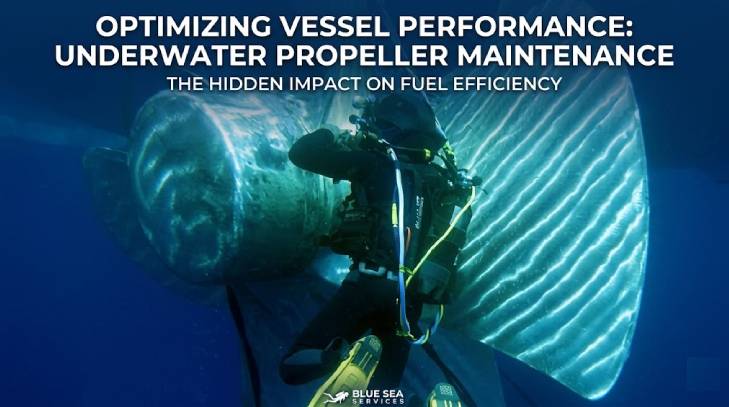
Introduction: The Invisible Thief of Vessel Performance
In the shipping industry, margins are tighter than ever. While most managers focus on hull fouling, there is an “invisible thief” sitting at the stern of your vessel: Propeller Roughness.
Even a thin layer of slime or a few calcareous deposits on your propeller blades can disrupt the laminar flow of water, forcing your engine to work harder to maintain speed. At Blue Sea Services, we consider propeller polishing the “low-hanging fruit” of maritime maintenance—it is a relatively low-cost intervention that provides an immediate, measurable return on investment (ROI).
1. Why “Clean” is Not Enough: Understanding the Rupert Scale
Many ship owners believe that simply knocking off barnacles during a hull cleaning is sufficient. However, from a hydrodynamic perspective, “clean” is not the same as “efficient.”
To achieve true fuel savings, the propeller must be polished to a specific smoothness measured by the Rupert Scale. This scale ranges from Grade F (very rough) to Grade A (mirror finish).
At Blue Sea Services, our divers are trained to achieve Grade A finishes. By reducing surface roughness to less than 6 microns, we minimize the “skin friction” that causes turbulence and power loss.
2. The Financial Impact: How Much Can You Save?
The math behind propeller polishing is simple. A fouled or rough propeller can increase a vessel’s fuel consumption by 3% to 8%.
For a medium-sized container ship or tanker, an 8% reduction in fuel consumption can save thousands of dollars in a single voyage. When you compare the cost of a one-day diving operation in Karachi or Port Qasim against the monthly fuel savings, the service often pays for itself within the first few days of sailing.
Key Benefits Include:
- Restored RPM: Allow your engine to reach optimal revolutions without over-torqueing.
- Vibration Reduction: A smooth, balanced propeller reduces stress on the tail-shaft and bearings, preventing long-term mechanical failure.
- CII Compliance: Lower fuel burn directly improves your vessel’s Carbon Intensity Indicator (CII) rating under IMO regulations.
3. The Blue Sea Services Process: Precision Beneath the Waves
We don’t just scrub blades; we engineer efficiency. Our multi-stage polishing process is designed to protect your assets:
- High-Definition CCTV Inspection: We begin with a visual audit to identify the level of fouling and any physical damage to the blade edges.
- Multi-Stage Hydraulic Polishing: Using flexible, specialized abrasive discs, we gradually move from coarse to ultra-fine polishing without removing the parent metal of the bronze-aluminum alloy.
- Detailed Technical Reporting: Every client receives a comprehensive report featuring “Before and After” photography and a confirmed Rupert Scale reading.
4. Strategic Advantage: Polishing in Pakistan
Vessels transiting the Indian Ocean often face heavy fouling due to warm water temperatures. Scheduling your maintenance during a port call at Karachi Port, Port Qasim, or Gwadar is a strategic move.
Blue Sea Services offers 24/7 availability, allowing us to perform polishing at the anchorage or during cargo operations. By utilizing our DNV and ClassNK certified teams in Pakistan, you receive international-grade technical work at a significant cost advantage compared to regional hubs.
Conclusion: Don’t Leave Money in the Water
If your vessel hasn’t had its propeller polished in the last six months, you are likely burning more fuel than necessary. In the modern maritime economy, efficiency isn’t just an option—it’s a competitive necessity.
Ready to restore your fleet’s performance? Contact Blue Sea Services today for a precision propeller polishing quote.